

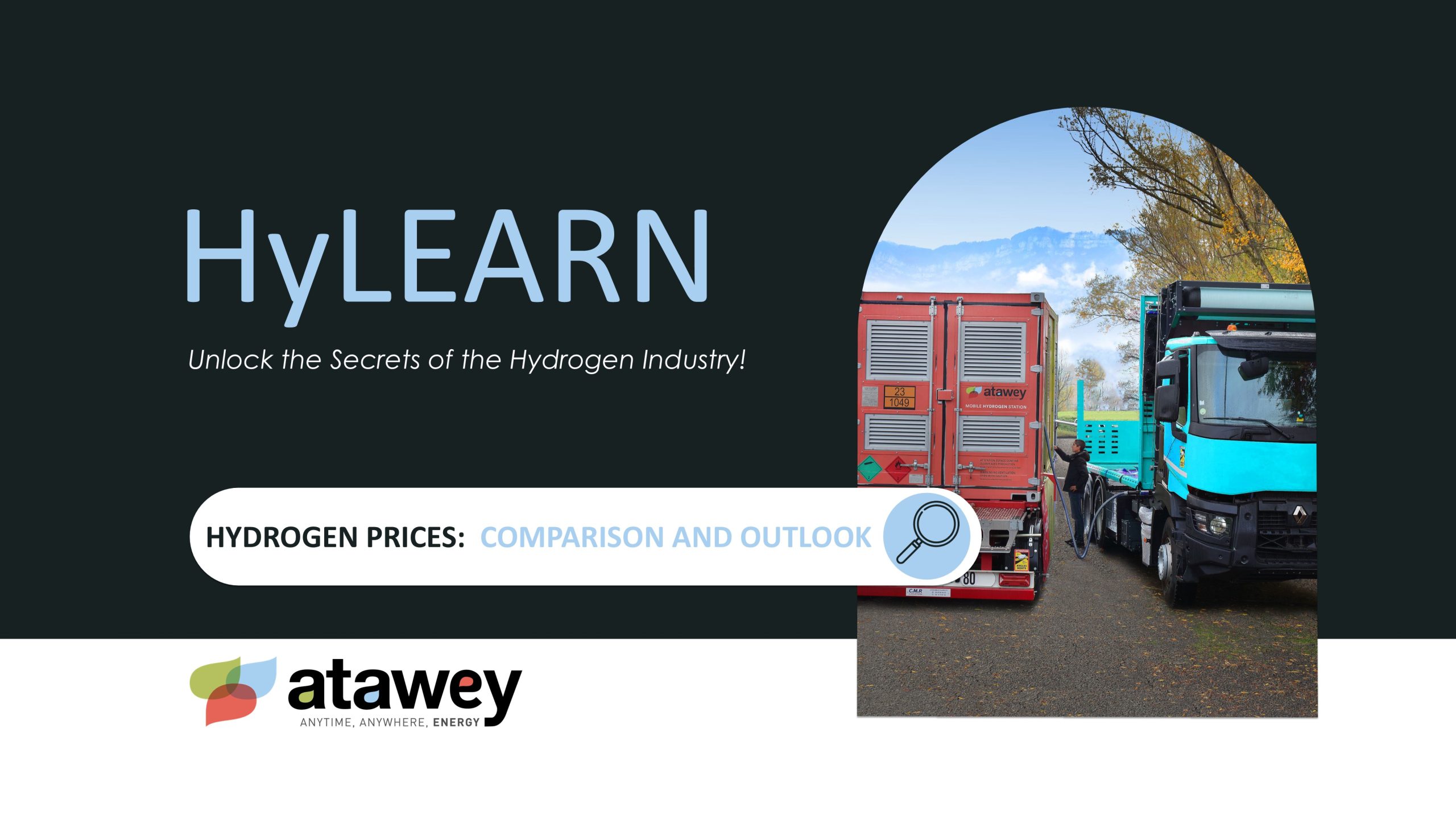
Hydrogen Prices in 2026: Cost per kg, Refuelling Costs, Comparisons and 2030 Outlook
Global hydrogen demand reached nearly 100 million tonnes in 2024, confirming its strategic role in decarbonising industry and heavy transport. However, today, almost 99% of hydrogen produced worldwide still comes from fossil sources, primarily natural gas and coal, significantly limiting its actual decarbonisation impact when assessed over its full lifecycle.
In this context, European policies are focusing on the development of low-carbon and renewable hydrogen to support the energy transition. Nevertheless, its large-scale deployment remains closely tied to a central question: its cost.
In 2026, hydrogen production costs range from €1 to €4/kg for grey hydrogen, €3 to €5/kg for blue hydrogen, and €5 to €9/kg for green hydrogen. These differences are significant and far from random. Let’s take a closer look at the factors influencing hydrogen costs and prices, as well as the outlook towards 2030.
What factors influence hydrogen prices?
Hydrogen prices depend on a combination of technical, logistical, and geopolitical variables. Each link in the value chain—from production to distribution—impacts the final cost. In this article, we provide an overview of the main factors shaping hydrogen prices on the international market.
Factor #1: Production costs
The production process is the primary driver of hydrogen pricing. Three main production pathways are currently distinguished based on their environmental impact:
- Grey hydrogen: produced from natural gas. It is currently the cheapest solution but also the most polluting, as it generates significant CO₂ emissions.
- Blue hydrogen: based on the same process as grey hydrogen, but with carbon capture and storage (CCS or CCU – Carbon Capture Utilization). It emits less CO₂ but is more expensive.
- Green hydrogen: produced through water electrolysis using renewable electricity. This method delivers the lowest carbon footprint, but electricity can account for up to 70% of total costs. In short: the higher the electricity price, the higher the cost of renewable and low-carbon hydrogen.
Production costs represent the largest share of the final price—but not the only one. Once produced, hydrogen must still be stored and transported.
Factor #2: Storage and conditioning
Hydrogen is the lightest molecule, which makes its storage and transport technically challenging and cost-intensive. It can be:
- Compressed in gaseous form, requiring very high pressures (up to 1,000 bar), with significant energy consumption;
- Liquefied at -253°C, which involves very high energy costs;
- Converted into stable chemical carriers (such as ammonia or methanol), requiring energy-intensive transformation processes.
Each of these options consumes energy and therefore increases the final cost. Beyond conditioning, the distance between production sites and end-use locations also plays a key role.
Factor #3: Transport
Once hydrogen is produced, it must be delivered. Logistics directly impact the price at the pump, depending on the transport method:
- Trucks (tube trailers): suitable for short distances but not cost-efficient over long distances;
- Ships: mainly used for liquid hydrogen, suitable for large-scale imports;
- Pipelines: cost-effective in the long term but requiring significant upfront infrastructure investment.
The denser the network, the lower the costs.
Factor #4: Origin
Hydrogen can theoretically be produced anywhere, but its price varies depending on:
- The availability of renewable electricity,
- Labour and infrastructure costs,
- Local regulatory frameworks and public policies (carbon taxes, subsidies, quotas).
These factors partly explain the price differences observed between regions such as Europe and Asia. Europe currently prioritises low-carbon hydrogen, which increases costs in the short term but reduces the overall climate impact.
Having reviewed the main cost drivers, let us now look at actual market price levels.
How much does 1 kg of hydrogen cost?
Unlike fossil fuels, typically expressed in €/litre, hydrogen costs and prices are expressed in euros per kilogram (€/kg).
What are hydrogen production costs?
As of early 2026, hydrogen production costs are as follows:
- Grey hydrogen: €1 to €4/kg
- Blue hydrogen: €3 to €5/kg
- Green hydrogen: €5 to €9/kg
Note: The recent drop in natural gas prices in 2025 temporarily widened the gap between green and fossil-based hydrogen. However, the industrialisation of electrolyser manufacturing and increasing production capacities are expected to gradually reduce this difference.
These production costs form the basis of hydrogen sales prices for industrial applications. In the mobility sector, however, the price at the pump also includes logistical costs.
How much does a hydrogen refuelling cost?
Hydrogen refuelling costs vary by country. According to recent IEA data:
- Japan / China: around €6/kg
- Europe (2025): between €10 and €20/kg, depending on station density and supply models
In practical terms, this represents:
| Vehicle Type | Average Tank Capacity | Refueling Cost in Europe | Refueling Cost in Asia |
| Light-Duty Vehicles | 6 kg | €60 to 120 | ~ €36 |
| Buses | 30 kg | €300 to 600 | ~ €180 |
| Coaches | 50 kg | €500 to 1 000 | ~ €300 |
| Short-haul trucks | 40 kg | €400 to 800 | ~ €240 |
| Long-haul trucks (44t tractor) | 60 kg | €600 to 1 200 | ~ €360 |
Note: Europe prioritises low-carbon hydrogen produced via renewable electrolysis or with carbon capture. This strategic choice leads to higher short-term costs.
Conversely, some Asian regions still rely more heavily on grey hydrogen, which is cheaper but more carbon-intensive. This lowers pump prices, further reinforced by strong government support mechanisms in these regions.
Given these still relatively high price levels, a key question arises: can green hydrogen become more competitive in the coming years?
Green hydrogen: will hydrogen prices decrease in the coming years?
Global electrolysis capacity now exceeds 3 GW, compared to 1.4 GW in 2023 and 2 GW in 2024. The momentum is real, although still largely concentrated in China.
In Europe, approximately 0.6 GW of electrolysis capacity was already operational by mid-2025, with more than 2.8 GW under construction or in pre-FID (Final Investment Decision) stages.
While growing, these volumes still represent less than 1% of global hydrogen production. In other words, the growth potential remains considerable.
Reducing the cost of green hydrogen is therefore a major industrial challenge worldwide. Several levers could contribute to this decrease in the coming years.
Lever #1: Declining renewable energy costs
Electricity is the main cost component in green hydrogen production.
As renewable energy costs decrease, hydrogen costs follow naturally.
In addition, smart energy management systems enable production to be optimised: producing more when electricity is abundant and cheap, and less when prices rise.
Producing at the right time thus becomes a key economic lever.
Lever #2: Improvements in production costs
The second variable is technological.
Electrolysers (alkaline, PEM, SOEC) are becoming more efficient, requiring less electricity to produce the same amount of hydrogen. Since electricity can account for up to 70% of total costs, this is a major factor.
Manufacturers are also working on more durable and cost-effective materials, extending equipment lifetimes and reducing lifecycle costs.
Finally, industrial scaling plays a critical role. As production volumes increase, unit costs decline—a classic economies-of-scale effect.
Lever #3: Hydrogen mobility – structuring production and distribution ecosystems
In hydrogen mobility, cost reductions do not depend solely on technology but also on network organisation.
An efficient model often relies on:
- Centralised production units,
- Satellite refuelling stations located close to end uses.
This structure enables:
- Sharing of heavy investment costs,
- Reduced operating costs,
- Shorter transport distances,
- Progressive capacity adjustments in line with actual demand.
In short, the more structured the network, the lower the cost per kilometre.
These three dynamics—declining renewable and low-carbon energy costs, technological progress, and the structuring of hydrogen refuelling networks—are creating the conditions for gradual cost reductions.
The trajectory will not be linear. It will depend on electricity prices, carbon pricing, and investment pace.
However, the underlying trend is clear: as the sector industrialises, the cost gap with fossil fuels will narrow.
What are the projections for the coming years?
By 2030, the most optimistic global projections suggest:
- Grey hydrogen: stable pricing, but decreasing policy support,
- Blue hydrogen: declining costs, approaching grey hydrogen levels,
- Green hydrogen: potential costs of €2 to €3/kg in highly favourable regions
However, only certain projects will actually reach these targets. Deployment speed will heavily depend on public policies and carbon pricing.
Cost reductions alone are not sufficient to ensure competitiveness, which also depends on comparisons with alternative energy solutions and regulatory frameworks.
Will green hydrogen become competitive?
Recent data suggests that European clean hydrogen production could reach around 2.3 Mt/year by 2030, with a significant share coming from electrolysis. This would represent a substantial scale-up compared to current levels.
Green hydrogen could therefore become competitive between 2030 and 2035, particularly in:
- Heavy industry (steel, chemicals),
- Long-distance transport,
- Hard-to-electrify sectors,
provided that renewable electricity remains competitive and carbon pricing increases.
In the most favourable scenarios, green hydrogen prices could fall to around €2 to €3/kg in regions with abundant, low-cost renewable electricity, making it competitive for heavy industry and long-distance transport.
To accelerate this cost convergence, many governments have implemented support mechanisms.
Are there subsidies to reduce hydrogen costs?
Beyond market dynamics, green hydrogen competitiveness also relies on strong public support at both national and European levels.
In France, the IRICC (Incentive to Reduce the Carbon Intensity of Fuels)—which replaces the TIRUERT (Incentive Tax on the Use of Renewable Energy in Transport)—encourages the use of low-carbon fuels. This fiscal mechanism requires a minimum share of low-carbon hydrogen in transport fuels.
Other European countries have introduced similar schemes. In the Netherlands, the SDE++ mechanism supports low-carbon hydrogen production by compensating the cost gap with fossil fuels. In Germany, new funding programmes launched in 2026 aim to accelerate the deployment of hydrogen refuelling stations and fuel cell trucks, confirming the strategic importance of hydrogen mobility.
At the European level, the Clean Hydrogen Partnership has mobilised over €1 billion in public funding to support more than 250 projects covering electrolysis, heavy mobility, and storage. These investments aim to accelerate technological maturity and reduce costs through scale effects.
Finally, carbon taxes applied to greenhouse gas emissions are gradually penalising fossil fuels.
These mechanisms are designed to support the emergence and long-term sustainability of a strong and competitive European hydrogen sector.
In conclusion, hydrogen prices remain a barrier to large-scale adoption, particularly in mobility applications (excluding passenger vehicles). However, industrialisation, declining renewable energy costs, and increasing climate pressure are progressively reshaping the equation. In 2025, the first installations above 50 MW entered into operation—marking a key milestone for the sector.
By 2030, green hydrogen could become competitive for certain key uses. Not everywhere. Not for everything. But precisely where direct electrification falls short.
Q&A: Hydrogen prices
Between €1 and €9/kg depending on the production method. At the pump in Europe: €10 to €20/kg.
Because it requires renewable electricity and still-costly electrolysers. Electricity accounts for the majority of costs.
Europe prioritises low-carbon hydrogen, which is more expensive in the short term, while some Asian regions still rely more on grey hydrogen. This is further amplified by strong government support for production in those regions.
Yes, driven by economies of scale, declining renewable energy costs, and public support mechanisms.
It is already viable in certain heavy industrial sectors but remains less competitive for mobility applications.
References
The estimates and projections presented in this article are based on data from the International Energy Agency (IEA), Hydrogen Europe, and the Hydrogen Council, covering the period from 2023 to 2025.
Data synthesis from the following sources: IEA Global Hydrogen Review 2024 ; IEA Global Hydrogen Review 2025 ; Hydrogen Europe Clean Hydrogen Monitor 2024, Hydrogen Europe Clean Hydrogen Monitor 2025 ; Clean Hydrogen Partnership Program review report 2024 ; RTE Bilan Prévisionnel 2023-2035, Hydrogen Council Closing the cost gap.